What Happens If You Measure Your Windows Wrong?
July 5, 2026
A Small Error With a Large Price Tag
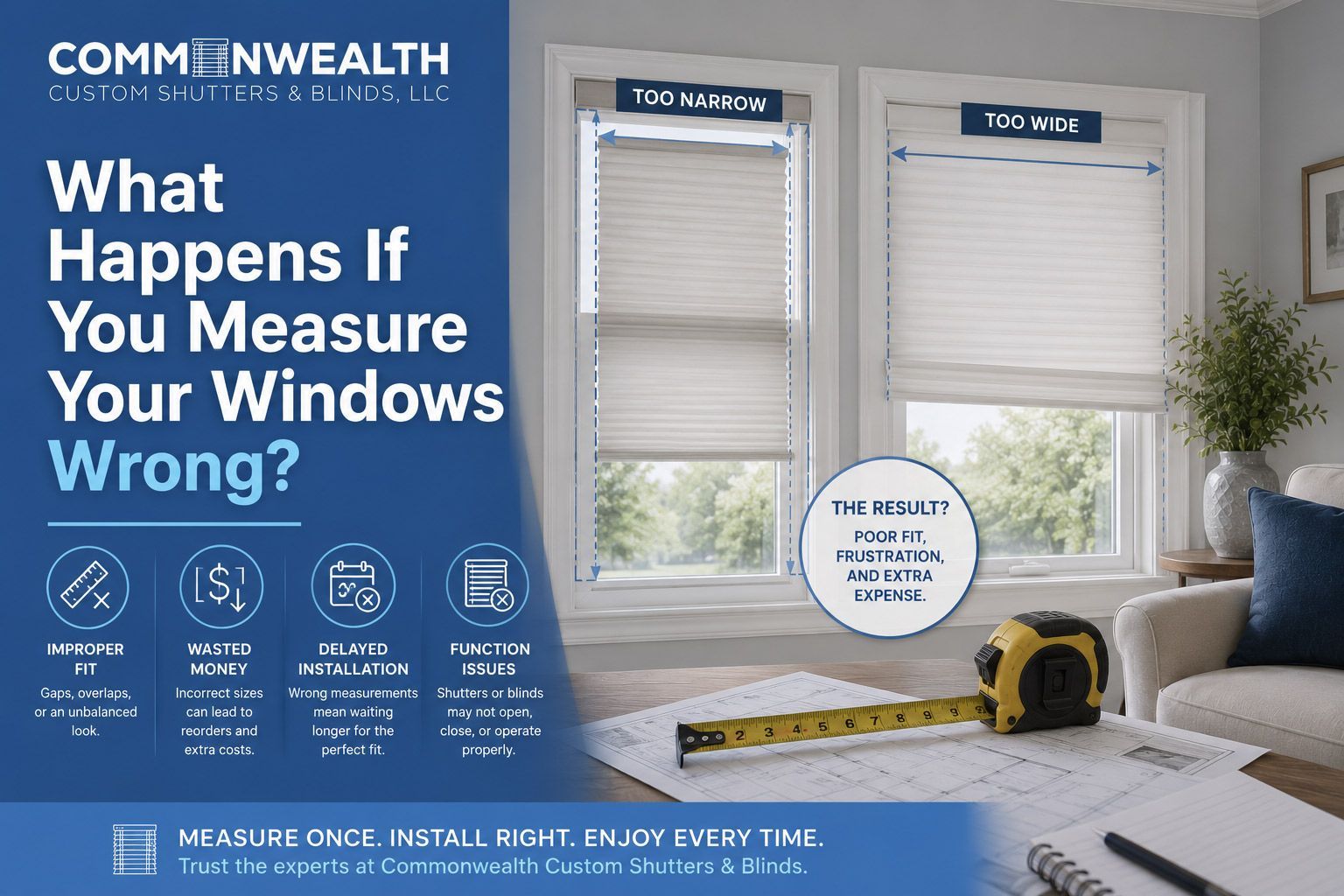
Measuring a window sounds like the simplest part of a window treatment project. Take a tape measure, write down the numbers, move on. But window measurement is where more DIY projects go wrong than homeowners expect — and the cost is not a minor inconvenience. Custom-fabricated window treatments cannot be returned. They are built to your specifications, which means a measurement error doesn't produce a refund. It produces a product that doesn't fit, a delay of several weeks for remanufacturing, and often an additional out-of-pocket cost on top of what you already spent.
For homeowners in Lexington, KY considering a self-measured order, understanding exactly where measurement goes wrong — and what happens when it does — makes the value of professional measurement much easier to assess.
The Three Most Common Measurement Mistakes
Most measurement errors fall into one of three categories. They happen not from carelessness but because window measurement involves more nuance than first-time buyers expect.
1. Measuring at Only One Location
Almost no window is perfectly square. Frames shift over time, walls settle, and even new construction rarely produces a true rectangle when measured precisely. Width measured at the top may differ from the width at the bottom by a quarter inch or more — enough to cause an inside-mount product to bind on one side or show a gap on the other.
The correct approach is to measure at three points — top, middle, and bottom for width; left, center, and right for height — then use the smallest width for inside-mount products and the largest for outside-mount.
2. Confusing Inside-Mount and Outside-Mount Dimensions
Inside-mount treatments sit within the window frame opening. Outside-mount treatments overlap the frame and attach to the surrounding wall. These two installation types require completely different measurements. An inside-mount measurement submitted for an outside-mount order produces a treatment too small to cover the opening. An outside-mount measurement applied to an inside-mount order produces a product too large to fit within the frame.
This confusion is especially common for homeowners ordering their first custom treatment. It cannot be corrected without remanufacturing the product.
3. Ignoring Frame Obstructions
Window cranks, handles, locks, and tilt latches can protrude significantly into the frame opening. An inside-mount treatment that fits the opening dimensions precisely may still be non-functional if a crank handle sits directly in its path. The same applies to unusually deep sills and interior trim that reduces usable frame depth.
Measuring accurately for the opening size without accounting for these obstructions produces a product that arrives at the correct dimensions but cannot be operated as intended.
What Happens When the Product Arrives Wrong
When a custom window treatment is delivered and doesn't fit, the path forward is rarely quick or clean. These are the most common outcomes homeowners in Lexington, KY face when a measurement error reaches the installation stage.
- Full replacement cost — manufacturers often remanufacture at a reduced fee, but rarely for free, and the homeowner typically bears the cost of the original error
- Forced workarounds — trimming, shimming, or improvising a mount to make an ill-fitting product work usually produces a visible compromise and may void the warranty
- Wasted trip fees — if an installer arrives to hang a product that cannot be installed correctly, the labor cost for that visit may still be charged
- Extended delays — custom remanufacturing typically adds two to four weeks, leaving windows uncovered while the replacement is produced
- Compounding damage — forcing a product that doesn't fit can damage both the product and the window frame, turning a correctable error into a larger problem
Why Professional Measurement Eliminates These Risks in Lexington, KY
Professional measurement is not just more accurate — it shifts the liability entirely. Here is what that means in practice.
- A professional installer assesses every variable that affects fit: frame recess depth, wall plumb, hardware locations, mounting surface condition, and whether the window is truly square — none of which a standard measuring guide covers fully
- When a professional measures your windows and an error occurs, the responsibility belongs to the installation company. The product is corrected or replaced at no additional charge. That protection disappears entirely when you supply the measurements yourself
- Commonwealth Custom Shutters & Blinds includes free professional measurement with every estimate throughout Lexington, KY — it is a standard part of the process, not an add-on
When DIY Measurement Can Work
For standard rectangular windows with no obstructions and consistent frame depth, a careful homeowner can produce usable measurements. The following conditions all need to be true for DIY to be a reasonable approach.
- The window is a standard rectangle with no arched tops, angled frames, or irregular geometry
- There are no obstructions — no cranks, handles, or deep sills — within the frame opening
- You measure at three points for both width and height, record width before height, and double-check every number before submitting
- The retailer or installer you are ordering from offers a measurement guarantee — if they don't, you are assuming 100 percent of the financial risk of any error
Frequently Asked Questions
Are some products more forgiving of measurement error than others?
A: Yes. Flexible fabric shades have slightly more tolerance for minor variations than rigid products like plantation shutters or wood blinds. But all custom products require accurate measurement for proper function and appearance — the tolerance difference is not wide enough to make imprecise measurement acceptable.
What tools do professional measurers use that most homeowners don't have?
A: Beyond a steel tape, professionals use levels to verify plumb, depth gauges for frame recess, and sometimes laser measures for wide or high openings. They also carry product-specific reference sheets specifying minimum depth and clearance requirements that vary by product and are not always available in standard ordering guides.
Should I measure myself and then have someone check my numbers?
A: It is better than measuring once and submitting without review. The most reliable approach is to measure independently at least twice, compare both sets of numbers, and resolve any discrepancy before ordering. If your two measurements don't agree, measure a third time rather than guessing which is correct.
What should I do if my window opening is clearly not square?
A: An out-of-square window requires professional assessment before ordering any inside-mount product. Ordering to nominal dimensions in an out-of-square opening produces a product that gaps or binds during operation. A professional will determine whether the product can accommodate the variation or whether outside-mount installation is the better path.
Do shutter measurements differ from blind measurements?
A: Yes, significantly. Plantation shutters require frame depth measurement to confirm the product will sit within the recess without protruding past the trim. Blinds are generally more forgiving of shallow frames. The measurement protocol changes by product, which is another reason professional measurement — with the specific product already selected — produces more reliable results.
Conclusion
A measurement error rarely ends at the mistake. It cascades into delays, extra costs, and workarounds that compromise the finished result. The simplest way to eliminate this risk is professional measurement — which Commonwealth Custom Shutters & Blinds provides free of charge throughout Lexington, KY and surrounding areas. There is no financial reason to measure yourself when expert measurement is already included in the process. Schedule your free appointment and protect your investment before a single product is ordered.