Are Motorized Window Treatments Worth the Investment?
April 26, 2026
Introduction: Convenience or Long-Term Value?
Motorized window treatments often spark one immediate reaction: they look convenient, but are they really worth the cost?
Homeowners in Lexington, KY frequently ask this when comparing traditional blinds or shades to automated options. Motorization increases upfront pricing, sometimes significantly. The real question is whether the added cost translates into practical value, energy savings, durability, or home appeal.
To answer that properly, you need to look at how motorized window treatments perform in everyday use and how that performance compares to standard manual systems.
What You Are Actually Paying For
Motorized window treatments are not simply blinds with a remote. The investment includes integrated systems designed for long-term function.
When you choose motorization, the pricing typically covers:
- Built-in motor mechanisms
- Power source, either battery or hardwired
- Remote controls or wall controls
- Smart home integration capability
- Programming and setup
- Professional installation and calibration
These components increase the base cost compared to manual blinds or shades.
Where Motorized Window Treatments Deliver Real Value
To determine whether the investment makes sense, it helps to look at the specific situations where motorization provides measurable benefits.
Hard-to-Reach Windows
In many Lexington homes, large living rooms and stairwells feature tall or high-mounted windows. Manual operation in these spaces can be inconvenient or even unsafe.
Motorization eliminates the need for ladders or extension poles, reducing wear and simplifying operation.
Large Window Walls
Modern homes often include wide glass expanses. Raising and lowering multiple shades individually can be time-consuming.
Motorized systems allow you to operate several treatments simultaneously with a single control.
Daily Privacy and Light Control
If you adjust your window treatments daily, automation reduces physical strain and makes consistent use more likely. Consistent operation can also improve energy performance.
The Financial Side: Comparing Cost vs Benefit
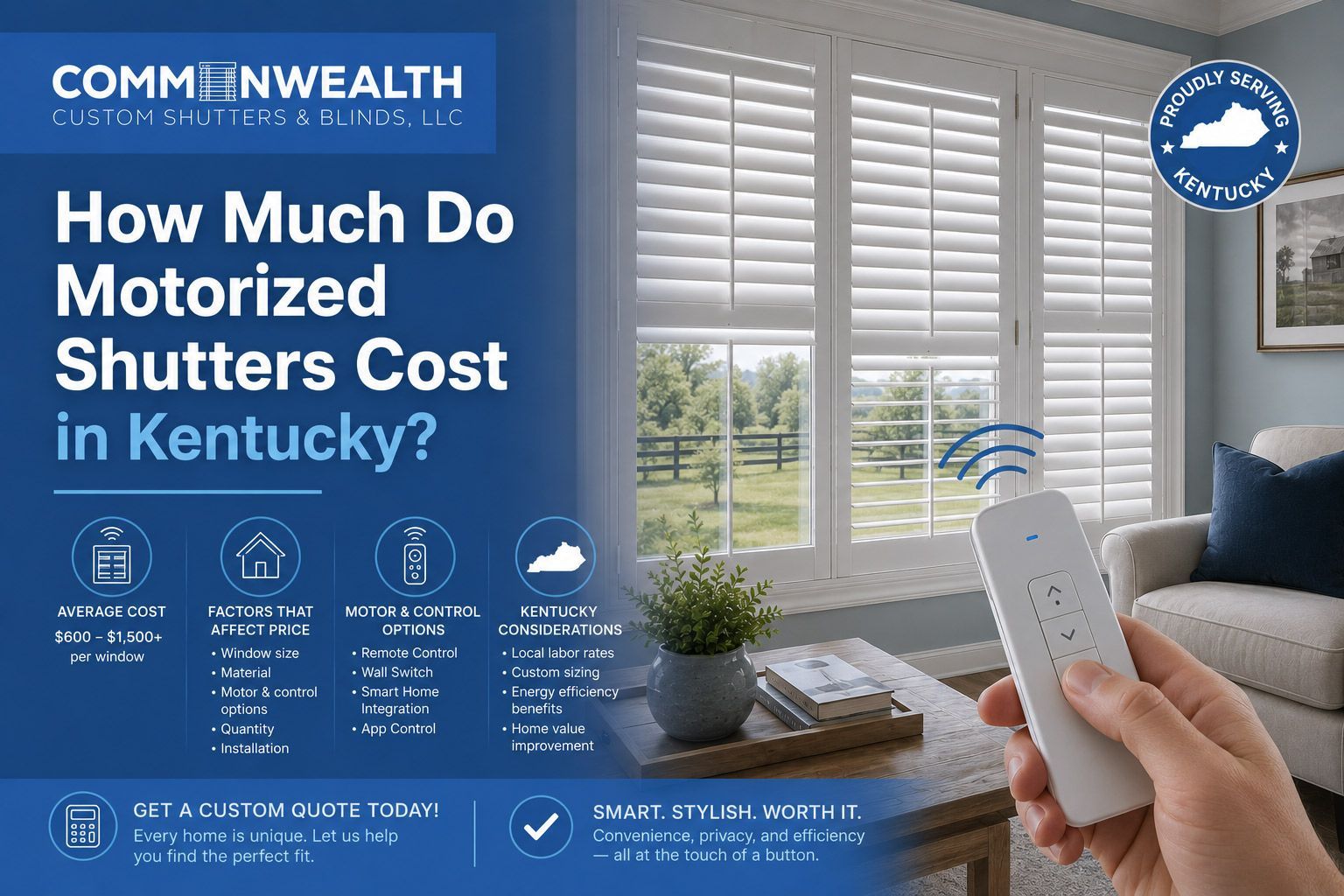
Motorized window treatments usually add several hundred dollars per window compared to manual options. Whether that increase is justified depends on how you use the space.
To evaluate the investment, consider the following factors:
- Frequency of daily adjustment
- Window height and accessibility
- Energy efficiency goals
- Home resale plans
- Desire for smart home integration
If blinds are rarely adjusted, motorization may offer limited practical value. If they are used multiple times per day across large windows, the investment becomes more reasonable.
Energy Efficiency and Climate Considerations in Lexington, KY
Lexington experiences humid summers and cooler winters. Managing sunlight exposure affects indoor comfort.
Motorized shades can be programmed to:
- Lower during peak afternoon sun
- Raise to allow winter sunlight
- Close automatically at night for insulation
Automated consistency can improve temperature regulation. While motorization alone does not guarantee lower utility bills, pairing automation with insulating shades may enhance efficiency.
Longevity and Wear
Manual blinds rely on repeated pulling, twisting, and tilting. Over time, cords and gears wear down.
Motorized systems reduce manual handling. That can decrease mechanical wear on certain components. However, motors introduce electronic parts that may eventually require servicing.
In most cases, quality motor systems are built for long-term performance when installed properly.
Comparing Manual vs Motorized Window Treatments
To clearly evaluate the difference, review how the two options compare in daily use.
| Feature | Manual Treatments | Motorized Treatments |
|---|---|---|
| Operation | Hand-operated | Remote or automated |
| Accessibility | May require reaching or climbing | Operates from floor level |
| Smart Integration | Not available | Compatible with smart systems |
| Upfront Cost | Lower | Higher |
| Convenience Level | Moderate | High |
This comparison highlights that the value of motorization is primarily in convenience and automation.
When Motorized Window Treatments Make the Most Sense
Motorization is often worth the investment under specific circumstances.
It makes strong sense when:
- Windows are tall or difficult to access
- Multiple shades need to operate together
- You are building or renovating a higher-end home
- Smart home integration is already in place
- Safety is a concern and cordless operation is preferred
In Lexington homes with expansive window layouts, motorization can feel less like a luxury and more like a practical solution.
When Manual Options May Be Enough
Motorization may not be necessary for every space.
Manual treatments may be sufficient when:
- Windows are easily reachable
- Adjustments are infrequent
- Budget constraints are a priority
- The home does not use automation systems
In smaller bedrooms or guest rooms, manual blinds often meet functional needs effectively.
Frequently Asked Questions
Do motorized window treatments increase home value?
They can enhance perceived value, especially in higher-end or newly renovated homes.
Are motorized blinds reliable?
Quality systems installed professionally are generally reliable, though electronic components may eventually require service.
Do motorized shades save energy?
When programmed properly and paired with insulating materials, they can help regulate indoor temperatures.
Are motorized window treatments safe for homes with children?
Yes. Cordless operation eliminates dangling lift cords, which improves safety.
How long do motorized systems last?
Lifespan depends on brand and usage, but many systems are designed for long-term daily operation.
Conclusion
Motorized window treatments are worth the investment when convenience, accessibility, and automation align with how you use your space. In Lexington, KY, homes with large windows, high ceilings, or modern layouts often benefit most from motorization.
While the upfront cost is higher than manual blinds or shades, the added control and streamlined operation can provide long-term satisfaction. Commonwealth Shutters and Blinds, LLC works with Lexington homeowners to evaluate whether motorized window treatments fit their home’s layout, lifestyle, and investment goals.